

Knowledge Hub
5
min read
OSS Modernization in Telecom: A Strategic Guide for Network Evolution
What is OSS Modernization in Telecom?
Why Telcos Are Prioritizing OSS Modernization?
From Legacy to Cloud-Native: Key Architecture Shifts
Strategic Pillars of Modern OSS Platforms
OSS Use Cases in the Modern Telco Environment
Implementation Path: How Telcos Should Approach OSS Modernization
Telecom networks are evolving faster than ever, yet many operators remain tied to systems built for another era. As new services, 5G demands, and cloud technologies reshape the industry, outdated OSS stacks can no longer keep up. The move toward OSS modernization is more than just a software upgrade. It is a shift toward agility, automation, and real-time control across the network. Embracing cloud-native and API-driven systems marks a turning point for telecom providers ready to move from legacy limitations to intelligent, adaptive operations.
.png)
What is OSS Modernization in Telecom?
Traditional OSS in telecom have historically been vertically integrated platforms, designed to manage core network functions such as service assurance, network inventory, fault management, and provisioning. While these systems provided foundational support, they were often constrained by siloed architectures, limited interoperability, manual workflows, slow time-to-market, and vendor lock-in. These limitations hinder operators from responding quickly to changing network demands or launching new services efficiently.
OSS modernization transforms these legacy systems into modular, cloud-native OSS frameworks. Modern platforms leverage microservices, standardized APIs like TM Forum Open APIs, and real-time analytics to enable seamless integration across network and business functions. Automation reduces manual interventions, allowing telecom operators to orchestrate networks dynamically, detect and resolve issues proactively, and optimize performance continuously.
This shift also supports hybrid network management, giving operators the ability to manage both physical and virtual network resources in a unified environment. Cloud-native OSS facilitates rapid, customer-centric service creation, reducing deployment delays and enabling agile response to market demands. Open interfaces not only lower vendor lock-in but also encourage innovation across telecom operations.
As Vodafone’s OSS lead noted in their 2023 transformation report, modernized OSS platforms are key to accelerating service delivery while maintaining operational efficiency and scalability. Industry benchmarks from Analysys Mason indicate that operators adopting cloud-native OSS report faster time-to-market for new services and measurable improvements in network reliability.
By modernizing OSS, telecom operators can achieve more agile, resilient, and efficient network operations, laying the foundation for API integration, improved orchestration, and end-to-end digital transformation. This evolution positions operators to deliver superior service experiences while maintaining operational excellence in a highly competitive telecom landscape.

.png)
Why Telcos Are Prioritizing OSS Modernization?
Telecom operators face mounting business and operational pressure to modernize OSS as networks grow more complex and customer expectations rise. Old OSS stacks were built for a simpler era. Today those systems limit an operator’s ability to move fast, control hybrid environments, and deliver differentiated services. Modernization is therefore a strategic priority that impacts agility, cost, compliance, and competitiveness.
Evolving Network Complexity
Operators now manage hybrid, multi vendor environments that include 5G, IoT deployments, fiber, and virtualized RAN components. Traditional OSS were designed for static hardware centric networks and offer limited cross domain visibility. They struggle to ingest real time telemetry or to coordinate distributed control for software defined network functions. Modern OSS modernization introduces systems that are modular and cloud native, supporting streaming telemetry, policy driven control, and dynamic network functions. That capability is essential to monitor and optimize service health across physical and virtual layers in real time.
Demand for Service Agility
Customer expectations have shifted from long lead times to instant experiences. Retail customers expect rapid activation and personalized plans. Enterprise customers demand network slicing, low latency profiles, and precise SLA enforcement. Modern OSS platforms enable intent based orchestration, automated discovery, and on demand provisioning so operators can create, test, and launch services quickly. These capabilities reduce manual touch points and let business and network teams deliver offerings that match market demand.
Reducing Time to Market and Operational Costs
Automation in OSS eliminates repetitive manual workflows and shortens fulfillment cycles from weeks to days or hours. Machine learning and AI applied to OSS datasets detect patterns, forecast faults, and recommend network optimizations before customers notice impact. Cloud native deployments reduce infrastructure overhead and enable continuous integration and continuous delivery practices that keep software current and secure. These changes lower operational cost, reduce mean time to repair, and accelerate feature delivery.
Competitive and Regulatory Pressures
New digital native competitors and hyperscalers bring agile operations and cloud first models into the market. To remain relevant, incumbent telcos must match that agility. OSS modernization also supports compliance with industry standards and regulatory expectations by enabling open interfaces and improved auditability. Open APIs are becoming a baseline requirement for cross ecosystem collaboration and for regulators that expect interoperability and fair access. Industry analyst benchmarks and operator case studies report measurable gains in provisioning time and reliability after modernization.
By prioritizing OSS modernization, operators gain the flexibility to manage hybrid networks, deliver services faster, lower costs, and meet regulatory expectations. Modern OSS becomes the operational backbone that supports service innovation, customer centricity, and long term competitiveness.
From Legacy to Cloud-Native: Key Architecture Shifts
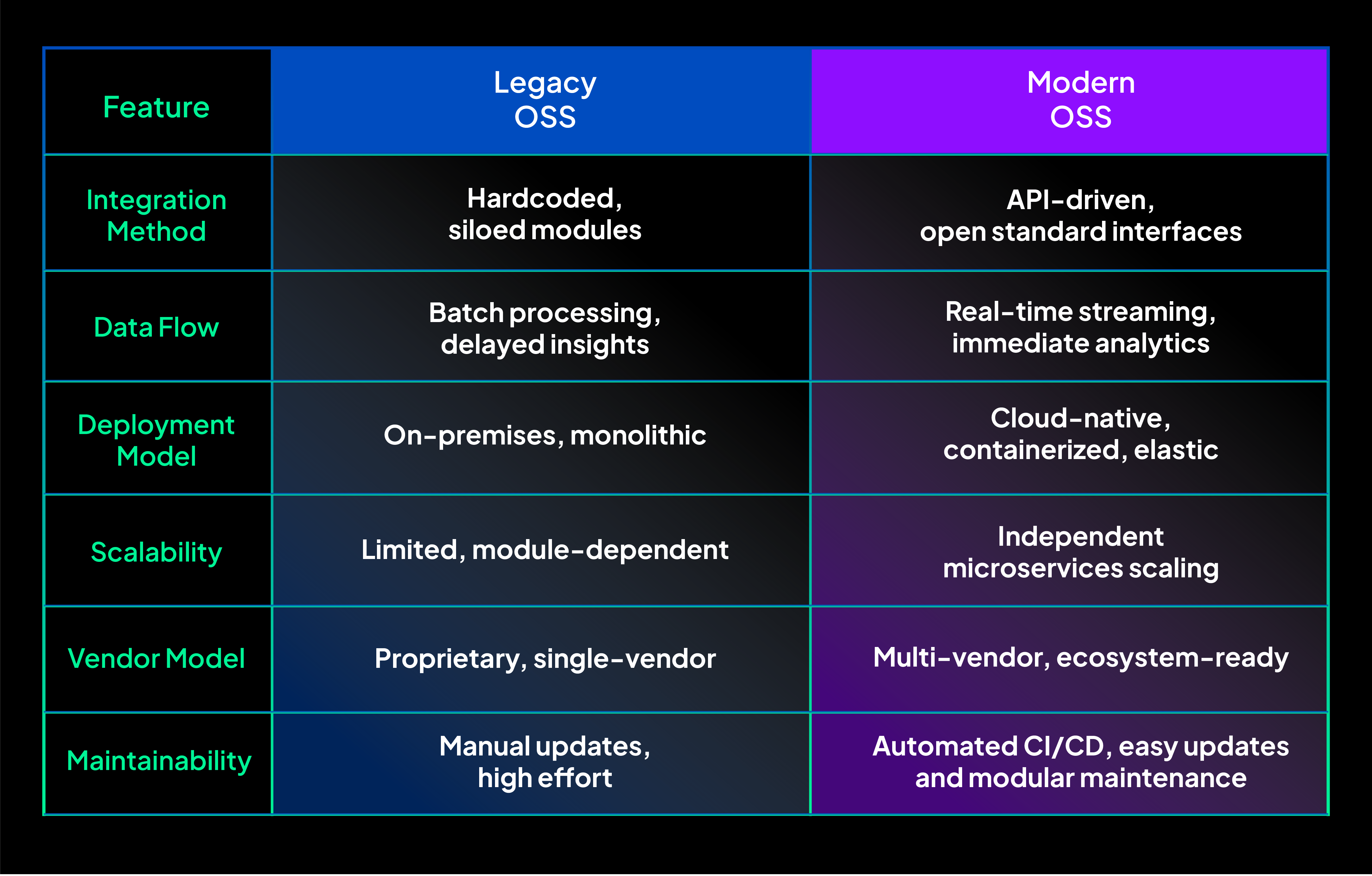
Telecom operators are reimagining how their Operations Support Systems (OSS) are built, deployed, and evolved. The shift from legacy to cloud-native OSS marks a defining step in how networks are managed, automated, and monetised. Instead of relying on rigid, monolithic stacks, operators are moving toward modular, service-oriented frameworks that align with digital transformation goals. These new OSS architectures are designed to deliver agility, resilience, and continuous innovation across complex, multi-domain environments.
Legacy OSS Architecture
Traditional OSS environments were vertically integrated and highly customised, designed to perform specific functions such as network inventory, configuration, fault management, and service provisioning. Each module operated in isolation, leading to data duplication, inconsistent workflows, and manual dependencies that slowed operations. This siloed structure limited visibility across domains, increased maintenance costs, and constrained innovation. The result was an environment characterised by static provisioning, lack of interoperability, and strong vendor lock-in, where even minor updates required extensive coordination and testing.
Cloud-Native OSS Principles
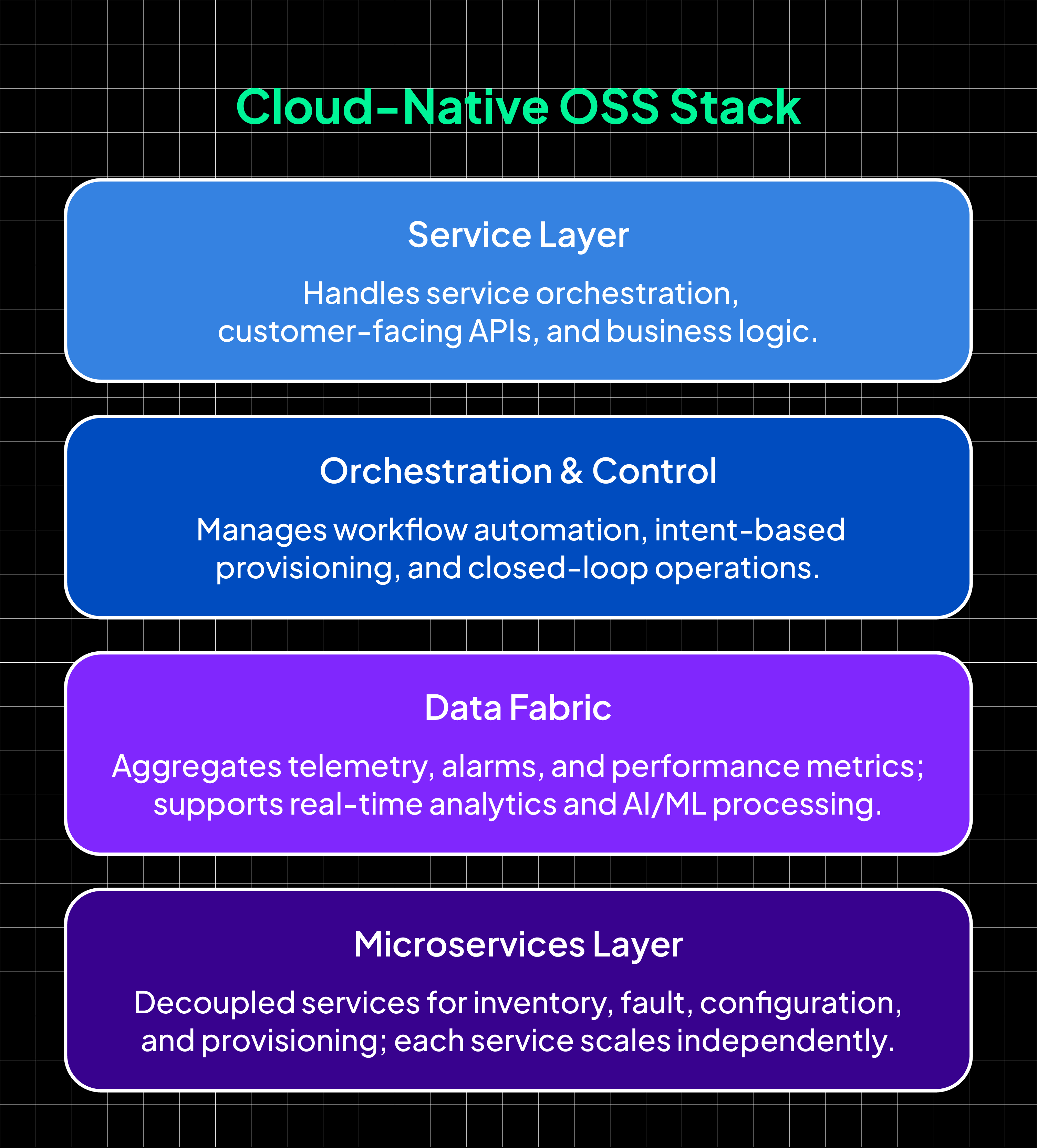
Modern OSS architecture embraces microservices, containerisation, stateless processing, and elastic scalability. By decoupling services, operators gain the flexibility to scale components independently and release updates without system downtime. Container orchestration tools such as Kubernetes make deployment and lifecycle management more efficient, supporting continuous integration and delivery practices. These design principles align closely with the Cloud Native Computing Foundation (CNCF), which defines best practices for building scalable and resilient cloud applications. Similarly, ETSI’s Zero-touch network and Service Management (ZSM) framework promotes autonomous network operations and closed-loop automation, ensuring networks can adapt dynamically to changing demands.
API-Driven Integration and Openness
The move to open, standardised APIs has redefined OSS interoperability. Instead of relying on hardcoded interfaces, telecom operators now use frameworks like the TM Forum Open APIs to enable seamless data exchange between systems and partners. This approach supports faster onboarding, cross-domain orchestration, and collaborative ecosystems where vendors and operators can innovate together.
Real-Time Data Architecture
Cloud-native OSS platforms replace static, batch-based processing with real-time data streaming. They process telemetry, alarms, service performance, and customer experience metrics as they happen, enabling proactive fault resolution and predictive maintenance. Real-time pipelines enhance operational visibility and power intelligent decision-making, driving automation and service quality to new levels.
Leading vendors such as Amdocs and Netcracker now deliver modular, cloud-native OSS solutions that embody these principles, helping telecom operators accelerate transformation and strengthen network agility.
Strategic Pillars of Modern OSS Platforms
Modern OSS platforms rely on several foundational capabilities that empower telecom operators to achieve agility, scalability, and intelligence in their network operations. These strategic pillars define how modern systems surpass the limitations of legacy OSS while supporting dynamic services and customer-focused operations.
Automation and AI Enablement
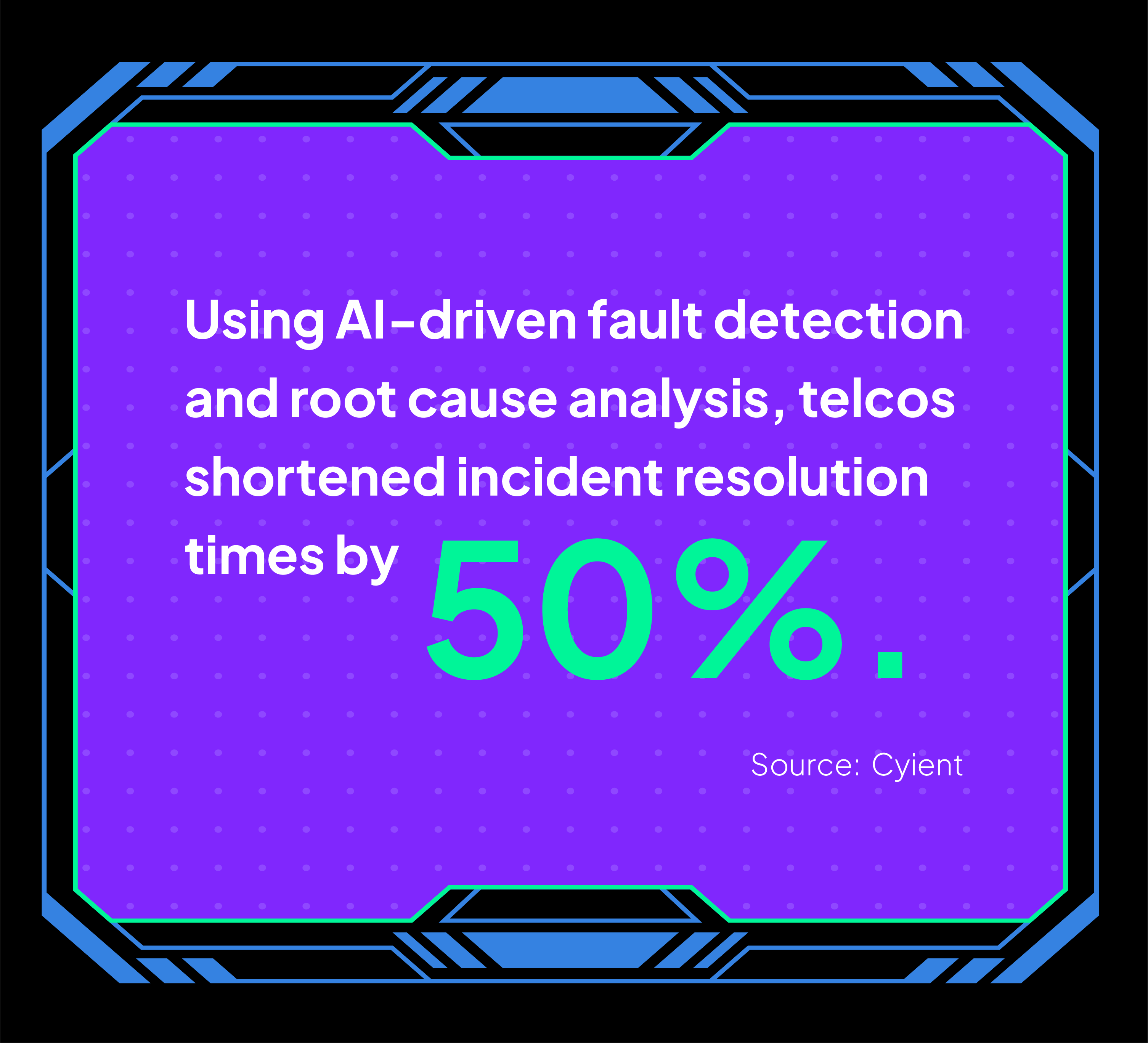
Automation is at the heart of modern OSS, replacing repetitive manual tasks in fault detection, service provisioning, assurance, and ticketing. AI and machine learning enhance these systems by predicting potential failures, performing root cause analysis, and enabling self-healing networks. Use cases include zero-touch provisioning, where services are activated automatically, and closed-loop assurance, which continuously monitors and corrects network conditions without human intervention. These capabilities reduce operational costs, accelerate service delivery, and improve overall network reliability.
Real-Time Inventory and Network Visibility
Unlike traditional OSS that provide static snapshot views of the network, modern inventory systems are dynamic, topology-aware, and capable of auto-discovery. They offer cross-domain visibility across physical, virtual, and logical assets, allowing operators to troubleshoot faster and plan capacity proactively. Real-time network insight is critical for managing hybrid environments that combine 5G, IoT, fiber, and virtualized resources. Operators can anticipate bottlenecks, optimize traffic flows, and respond to changing demand patterns in near real-time.
Open API Integration and Interoperability
Seamless interaction between OSS, BSS, orchestration platforms, and external partner systems is enabled by open APIs. TM Forum Open APIs are the global benchmark for interoperability, reducing the need for custom development and shortening onboarding cycles. They also support service chaining across domains, enabling operators to integrate new applications, partners, and services quickly. This API-first approach allows modern OSS platforms to remain flexible and ecosystem-ready, accelerating innovation without compromising operational stability. (STL Partners OSS Report, 2023)
Cloud-Native, Containerized Deployment
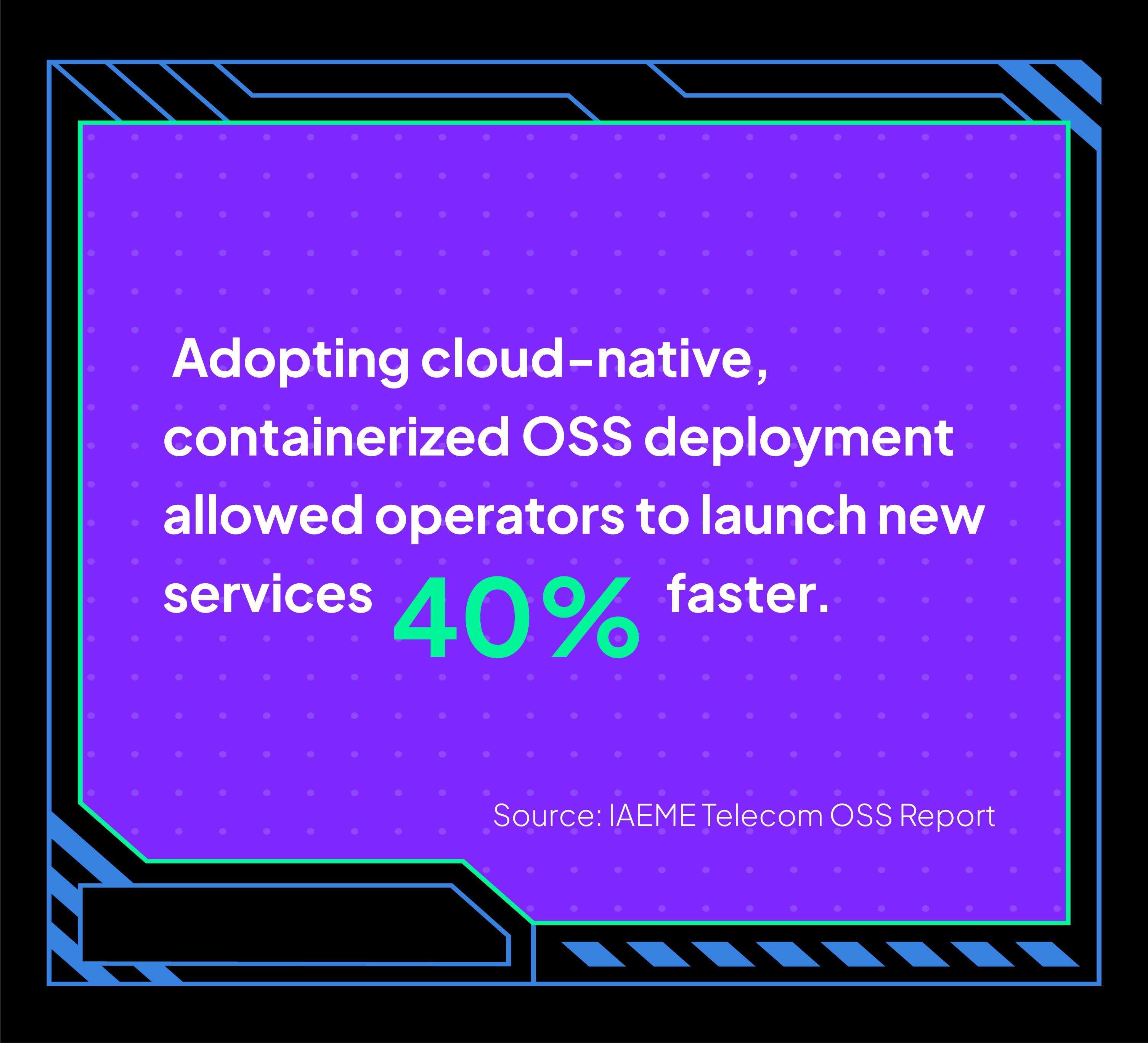
Modern OSS platforms leverage cloud-native, containerized deployment to deliver faster rollout, elastic scaling, and independent upgrades. Containers allow operators to modernize specific functions without replacing the entire system. Cloud-native deployment supports DevOps pipelines and continuous integration and delivery, which fosters iterative development and rapid service innovation. This modular approach ensures that OSS can evolve continuously, supporting new technologies and business models while minimizing downtime and operational risk.
By combining these four pillars of automation and AI, real-time inventory, open APIs, and cloud-native deployment, telecom operators can build OSS platforms that are resilient, agile, and prepared for future demands.


OSS Use Cases in the Modern Telco Environment
Modern OSS platforms deliver tangible value across a wide range of telecom scenarios. From 5G network slicing to IoT services, enterprise solutions, and MVNO integration, OSS modernisation enables operators to manage complex networks efficiently while improving customer experience. These real-world applications demonstrate how cloud-native, automated, and API-driven systems transform telecom operations, helping operators adapt to evolving service demands and competitive pressures.
5G Network Slicing Management
OSS plays a crucial role in 5G network slicing, enabling automated provisioning and lifecycle management of slices tailored to vertical-specific use cases such as automotive, healthcare, and industrial IoT. Real-time monitoring ensures SLA compliance and performance isolation, while integration with BSS systems allows dynamic pricing and monetisation of slice-based services. Operators can activate slices rapidly, track resource usage, and adapt performance parameters automatically, making service delivery more flexible and responsive. Modern OSS also provides analytics dashboards that track slice performance, capacity utilization, and latency metrics in real time, giving operators proactive control over complex 5G infrastructures.
IoT Service Enablement
Modern OSS supports onboarding, configuration, and fault management for millions of connected devices across multiple domains. Features like auto-discovery, zero-touch provisioning, and policy enforcement improve operational scalability and efficiency. Operators can manage device clusters, assign service plans, and monitor lifecycle events seamlessly. These capabilities make OSS for IoT a critical enabler for enterprises and consumer IoT deployments, reducing manual interventions and ensuring reliable service delivery. Cloud-native OSS architectures also allow operators to integrate IoT telemetry with analytics engines for predictive maintenance and automated alerts, providing tangible operational benefits.
Enterprise-Focused Custom Solutions
For enterprise customers, OSS customization ensures adherence to strict SLAs, service chaining, and quality metrics. Operators can orchestrate dedicated private 5G networks or edge deployments, offering on-demand bandwidth, latency adjustments, and detailed incident visibility. OSS platforms support workflow automation for provisioning, monitoring, and reporting, enabling enterprises to receive real-time insights and rapid resolution of network issues. By providing these tailored solutions, OSS platforms help businesses meet high-performance expectations while supporting dynamic network requirements.
MVNO and Digital BSS Integration
Integration of OSS with a digital BSS system simplifies onboarding and operations for MVNOs. Smaller operators benefit from pre-configured service catalogues, automated billing, and seamless service fulfillment. This integration is especially valuable for digital-first providers looking to scale rapidly with minimal infrastructure investment. OSS-driven automation reduces operational overhead, accelerates service launch, and ensures consistent customer experiences. Additionally, standard APIs and modular OSS frameworks enable these operators to expand into new regions or launch new services without extensive system redesign.
Modern OSS use cases demonstrate how operators can achieve agility, efficiency, and customer-centricity across their networks. By supporting 5G, IoT, enterprise deployments, and MVNO operations, these platforms validate the strategic importance of OSS modernisation in today’s competitive telecom environment. Operators that leverage these capabilities can unlock faster time-to-market, improved SLA compliance, and streamlined service orchestration, while future-proofing their networks against emerging technology demands.


Implementation Path: How Telcos Should Approach OSS Modernization
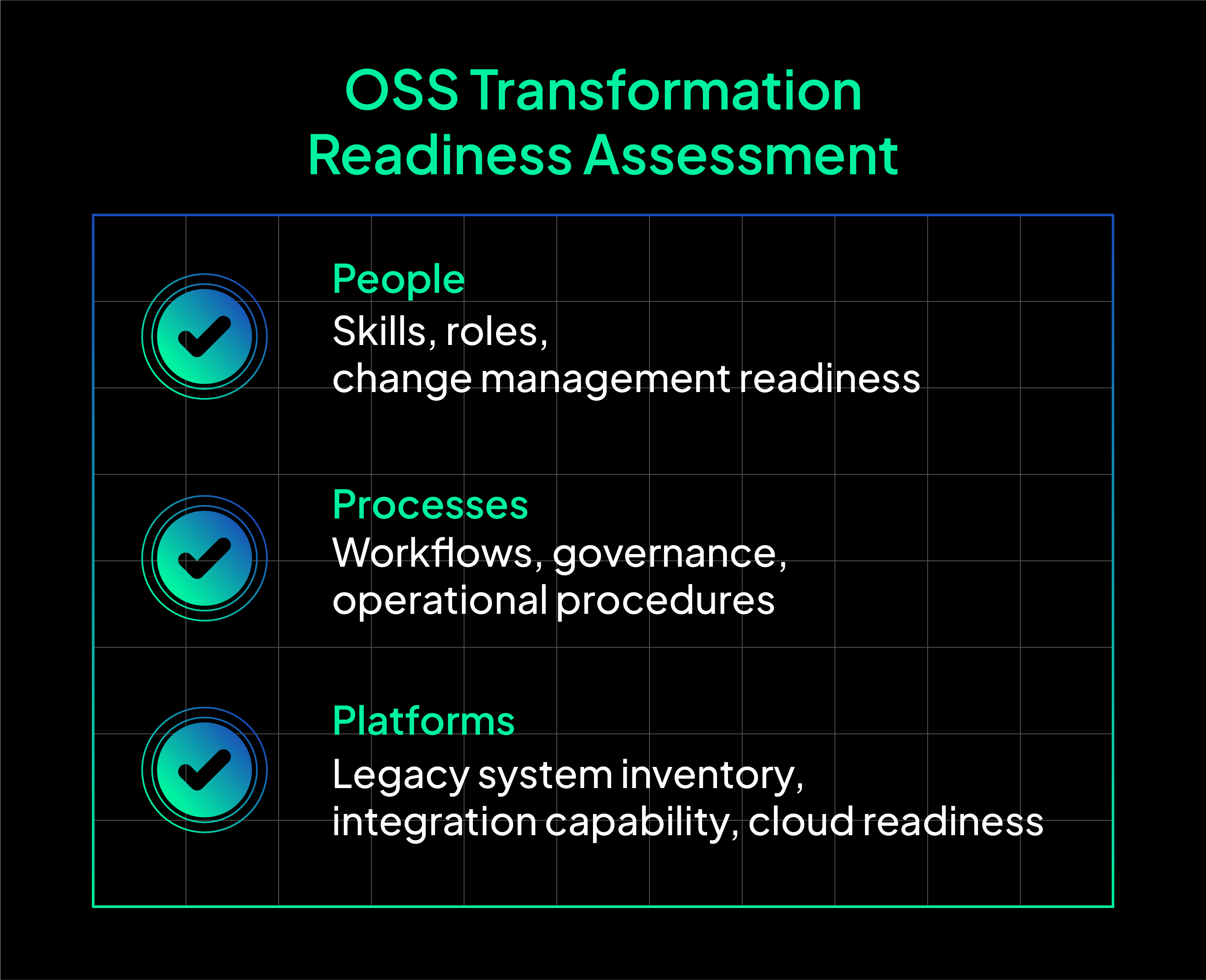
Modernizing OSS is a critical initiative for telecom operators aiming to improve agility, scalability, and operational efficiency. A structured, pragmatic approach ensures that transformation initiatives deliver value while minimizing disruption to ongoing network operations and mitigating legacy system migration risks. By evaluating legacy systems, defining clear objectives, and executing modernization in phases, operators can adopt cloud-native OSS capabilities and automation while maintaining service quality and business alignment. Leveraging DevOps best practices for telcos further ensures that iterative deployments are reliable, repeatable, and aligned with business priorities.
By following this approach, telecom operators can successfully transition from legacy OSS systems to modern, cloud-native platforms in a controlled, measurable, and business-focused manner. A combination of assessment, planning, phased migration, organizational readiness, and continuous optimization ensures that OSS platforms are agile, resilient, and prepared to meet the demands of modern networks.

Best Practices for Future-Proof OSS Architecture
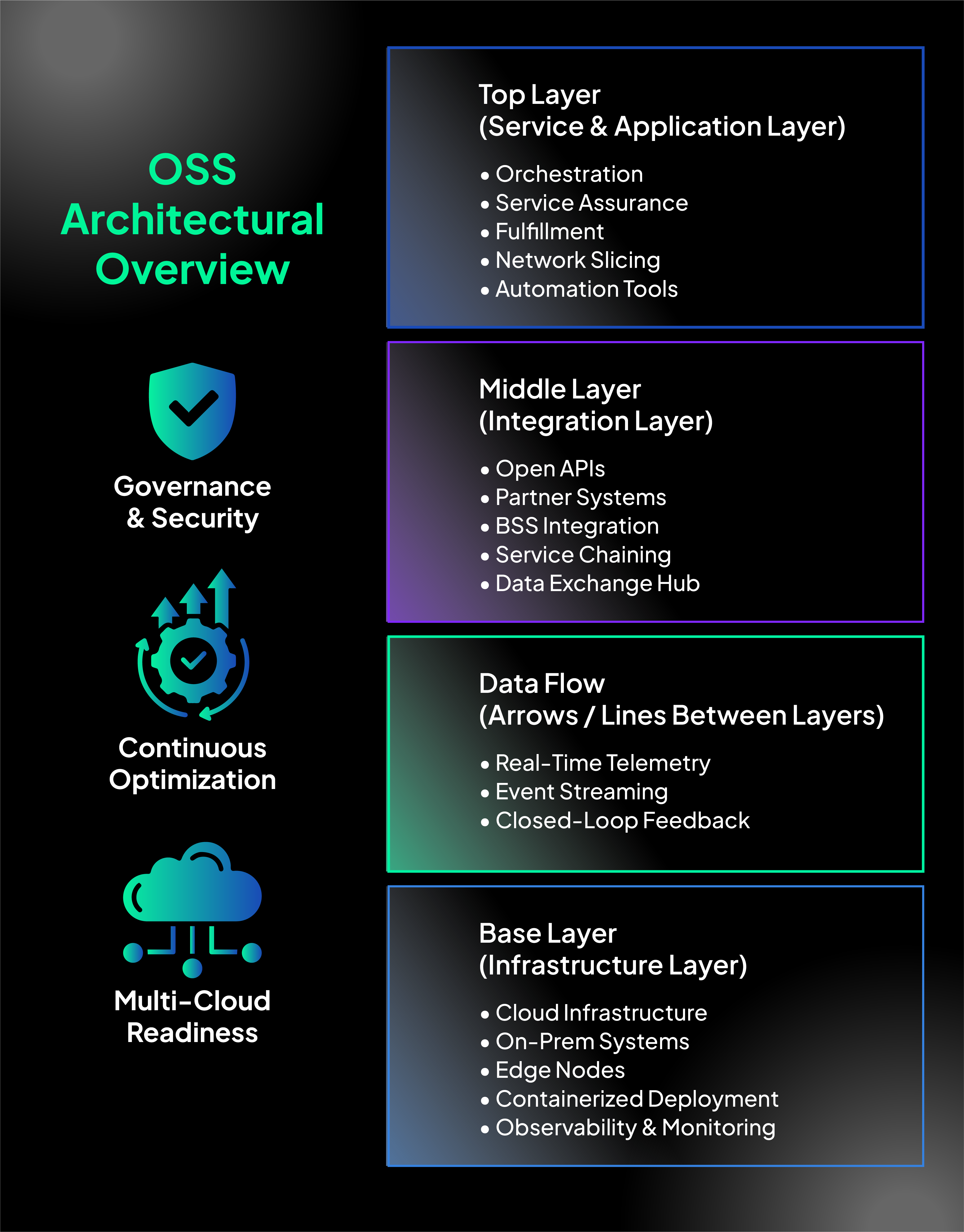
Designing a future-proof OSS platform is essential for telecom operators aiming to stay ahead of evolving network demands, service innovation, and technology shifts. A resilient OSS environment allows operators to scale services efficiently, respond to dynamic market requirements, and maintain operational stability. By adopting modular architectures, open standards, real-time observability, and robust governance, operators can ensure their OSS platforms remain agile, secure, and aligned with business objectives. The following best practices outline tactical recommendations to achieve these outcomes.
Implementing these practices equips telecom operators with a robust, scalable, and agile OSS foundation. Modular architectures, open standards, real-time observability, multi-cloud deployment, and integrated governance ensure the OSS platform can evolve alongside emerging technologies, support dynamic services, and maintain operational excellence. Operators that adopt these approaches position themselves to reduce risk, accelerate service delivery, and drive innovation across their networks.

Conclusion
OSS modernization is more than a technical upgrade; it is a strategic enabler that delivers lasting value for telecom operations. By adopting cloud-native OSS, open integration, and intelligent automation, operators can achieve greater service agility, operational transformation, and faster response to evolving market demands. Modernized OSS platforms enhance scalability, reliability, and alignment between network capabilities and business objectives. Delaying modernization increases long-term operational and competitive risks, potentially limiting growth and innovation opportunities.
Explore our OSS transformation frameworks or connect with our telecom consultants to start your journey.