

Insights
10
5
min read
MVNO Market Snapshot 2026: Ecosystems and Niche Markets Continue Attracting New MVNO Entrants
With rapid advancements to technology, it has never been easier to start up a new mobile operator brand or offer mobile plans as part of a brand’s service.
Thanks to these advancements, Mobile Virtual Network Operators (MVNOs) are seeing surprising additions to their ranks. On top of fintech and digital banks launching MVNOs, there are now energy drink groups, football clubs, celebrities, podcast hosts, and even the family firm of the President of the United States launching or considering launching them.1
In addition to the lower barriers to entry, many non-telco companies are drawn to offering MVNO services by the potential returns from targeting profitable but niche audiences and the insights gained from deeper and richer data that only mobile services can provide.
As a player within the mobile industry with years of both mobile operator brand experience and as an enabler of MVNO brands, this article offers Circles Aspire’s quick snapshot of the MVNO market, containing
A Snapshot of the MVNO Market in 2026
The global MVNO market is estimated to reach USD 79.97 billion in 2026 and projected to further grow to USD 109.48 billion by 2031, advancing at a 6.48% CAGR.2 Mordor Intelligence credits cloud-based enablement, prepaid subscriber pools, Internet of Things (IoT) traffic expansion, and wholesale-access regulation for this rise, though it is tempered by mobile network operators (MNOs) raising fees to support 5G and 6G infrastructure.

Currently, no single operator commands more than 5% share globally. Prominent discount brands like TracFone and Lycamobile are increasingly engaging in price competition, a dynamic intensified by MNOs aggressively promoting their own sub-brands. Meanwhile, digital-finance-branded MVNOs are capitalizing on their extensive know-your-customer databases to upsell and cross-sell their services.2
Enterprise-IoT specialists are also expanding their positions by competing on software-orchestration portals and improving global roaming footprints. These offerings resonate with multinational companies seeking SIM consistency across their logistics fleets and medical devices.2
Omdia, on the other hand, forecasts MVNO subscriptions to grow at 3.6 percent annually from 2023 to 2029, which is more than their predicted rate of personal mobile subscriptions (1.6 percent).3
Omdia's report also mentions that growth in the Americas will likely be led by Brazil, Mexico, and the USA, while MVNO growth in the Middle East & Africa will be led by South Africa and Nigeria. Asia & Oceania have the largest MVNO markets by subscriptions but will see modest growth. Europe is expected to see an MVNO contraction due to competition from operator sub-brands and because some MVNOs have decided to deploy their own mobile networks.3

Banks, supermarkets, and broadband TV providers are among key players in the MVNO market, along with fintech and digital banks like Revolut, as they can promote mobile services efficiently to their existing customers.
What’s Driving the Surge?
New Services Mean Stronger Average Revenue Per User
Some of the industries that are entering the MVNO market have low margins, such as supermarkets, or need more sources of income to offset high operating costs, like some fintech companies face.4
Companies like these offer mobile services as a source of predictable recurring revenue. Having a pool of long-term mobile customers also presents them with:
Players with large followings like Trump Mobile, Smartless Mobile, FC Barcelona, and Red Bull choose to develop MVNOs to monetize their audiences. As they understand these niches well, they can cater specific services or branding to them, such as Red Bull’s focus on sports highlights for their audience that loves sports and adrenaline-rushing activities.
Mehul Vora, VP of Sales from Circles Aspire, shares:

Already having significant foot traffic and existing member programs, many supermarket retailers are increasingly offering MVNO services as a profitable way to boost ARPU. While the grocery business often operates on a margin of between 1-3%, mobile services, on the other hand, could yield much higher returns, thus becoming a valuable supplement to the retailer's main operations. You can find more details about the business case behind this in this white paper.
Richer Data, Richer Services
Data continues to be treated as the new gold, especially by tech players. Digital service providers such as Revolut and Klarna as well as established brands like Tesco can benefit greatly from having telco data added to their customer segmentation insights.
Digital banks that have extensive know-your-customer databases benefit from richer information from mobile data plans, such as knowing what their customers are using their data on and when they use their data most frequently.
The Ecosystem Play: Cross-sell, Up-sell, and Retention
In its Q3 2020 Results Presentation, Rakuten, a global technology conglomerate based in Japan, mentioned that Rakuten Mobile helped attract new users to its ecosystem. In 2020, 15 percent of Rakuten Mobile’s applicants hadn’t used Rakuten before, and 35 percent of those new users started using various Rakuten services.
Capitec Connect, South Africa’s Capitec Bank MVNO, is using free mobile data as incentives for cross-selling, such as encouraging users to sign up for credit cards. Also, by capturing a larger share of a person’s lifestyle, brands like Capitec Connect can build stickiness by becoming harder to disconnect from while also allowing for more personalized loyalty rewards like tailored bundles, perks, rewards, and tiers.
These just mark the tip of the iceberg: richer customer data and experimentation can open the doors to rich non-telco digital services like e-commerce, gaming, finance, and more.
Advancements in MVNEs and ESIM Technology
Advances in back office and eSIM technology have powered new MVNE and MVNA platforms as key enablers. These platforms are now powering the expansion of non-telecom enterprises into launching Light or Brand MVNOs.
Light or Brand MVNOs are forecast to grow at 6.78% CAGR, outpacing heavier core-network investors.2 A Light MVNO delegates core network functions and subscriber management to its host partners, concentrating instead on brand positioning, ecosystem integration, fintech bundling, or retail loyalty cross-promotions.
This shift helps highlight the growing importance of modern MVNE ecosystems. Cloud-native enablement platforms now abstract much of the operational and technical complexity traditionally associated with telecom, allowing brands to concentrate on experience design, customer acquisition, monetization models, and ecosystem expansion.
Another key contributor to all this is eSIM technology. eSIM technology does away with the need for physical SIM cards, allowing for a fully digital onboarding experience while reducing customer acquisition costs. Digital and online-only channels accounted for 48.65% of new activations in 2025 and are projected to grow at a 7.23% CAGR through 2031.2
Self-service applications featuring embedded video KYC have reduced onboarding times to under five minutes, in contrast to traditional retail processes that depend on SIM packaging, point-of-sale scans, and physical identity verification. As remote eSIM provisioning eliminates inventory and distribution costs, the share of MVNO market growth driven through digital channels is expected to increase further.
This combination of low barriers to entry and the synergistic benefits that mobile services provide to various brands’ ecosystems are the drivers of the recent MVNO market boom. Some of these brands are also seeing some success, as shown below.
Validated MVNO Success Stories Across Industries
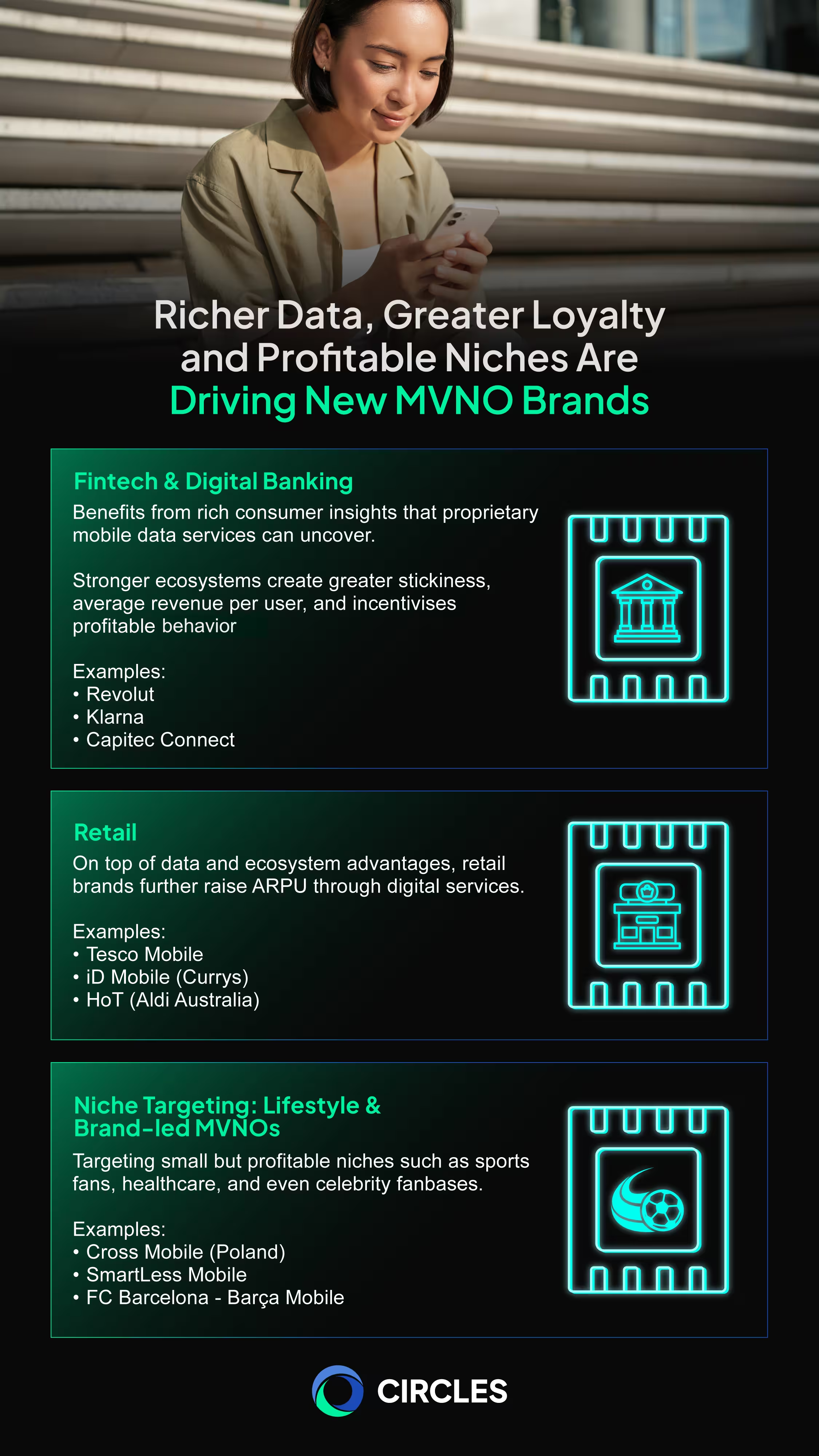
Fintech & Digital Banking: Richer Data, Richer Insights
Revolut
In 2024, Revolut launched a global eSIM service for premium users, offering cost-effective data plans directly within its app. Revolut later reported that year that Revolut’s eSIM was its number one non-banking product in terms of usage.5
By mid-2025, Revolut announced full MVNO plans in the UK and Germany providing unlimited domestic calls, texts, and data, along with substantial roaming allowances. Their roaming allows their customers to stay connected across one hundred countries with eSIM along with lounge access for Revolut’s travel-focused customer segment. It also has loyalty integration via RevPoints, making it a core part of Revolut’s ecosystem engine.
Klarna
Klarna entered the US mobile market with an unlimited phone plan integrated directly into its app.6 CEO Sebastian Siemiatkowski mentioned:
“With mobile plans we’re taking that one step further as we continue to build our neobank offering… one tap in the Klarna app, and you’re up and running.”
Klarna’s offer focuses on a simplified experience with no hidden fees and no friction, while adding to its digital experience ecosystem and customer retention moat.
Capitec Connect (South Africa)
Capitec Bank’s MVNO arm reached 1.6 million subscribers, growing 73.7% year-on-year. In South Africa, many people purchase data and airtime through their banks.7 Capitec Bank saw this as an opportunity to offer mobile network services directly to their 24 million banking clients and 13 million app users directly.8
This maneuver aims to capitalize on behavioral incentives to drive both telecom and banking loyalty, such as providing free monthly data for credit card holders.
Retail: Same Customer-base, Higher ARPU and Loyalty
Tesco Mobile (United Kingdom)
At the end of FY 2024, Tesco Mobile expanded its user base by 3.6% to 5.7 million while growing its revenue by 4.7% to £1.11 billion.9 Back in 2023, Tesco Mobile added over 200,000 new pay-monthly subscribers and boosted its pay-monthly market share by 12%, reinforcing its position as the UK’s largest MVNO with 5.5 million customers.10
The network also improved its churn performance as customers renewed contracts, and extended free EU roaming and Clubcard Price plans helped drive engagement and retention.
iD Mobile (Currys)
iD Mobile, the MVNO operated by consumer electronics retailer Currys, surpassed 2 million subscribers by late 2024, adding around 488,000 new customers over the past year. These milestones are well ahead of initial projections, reflecting a strong uptake of iD mobile’s budget-friendly service proposition.11
HoT (Austria)
HoT, the MVNO launched by Austrian retail giant Hofer (Aldi Austria), has grown into one of Austria’s leading virtual operators. By late 2023 to early 2025, HoT reported more than ~1.4 million customers, capturing around 9.2-10% MVNO market share in Austria as it expanded its subscriber base and retained its value-focused positioning in a highly competitive market.12
Bait (Walmart de México)
Walmart de México y Centroamérica’s Bait mobile service is an MVNO under its Walmart retail ecosystem. Bait reported 11.8 million active users in 2023, marking a 111% year-on-year growth in active subscribers.
At the same time, the service expanded its retail recharge footprint to more than 1.2 million physical recharge points, representing a 167% increase over the end of 2022, demonstrating rapid adoption among Walmart’s Mexican customer base.13
Aldi Talk (Germany and Other Countries)
Since its inception in 2005, Aldi-Talk has been a significant player among Germany's MVNOs. The service which offers no-frills, prepaid cell plans, fits well with Aldi's value-driven brand. The service is provided in several European markets like Germany, Belgium, the Netherlands, and Switzerland.
Customers can get SIM cards and recharge vouchers directly from Aldi stores; thus, there is no need for a separate shopping experience when it comes to mobile services. In Germany, Aldi Talk had an app engagement of 5.5 million by March 2025.14
Lifestyle & Brand-Led MVNOs: Monetizing Fans With Specialized Offers
Red Bull Mobile (Saudi Arabia)
Red Bull launched its MVNO in 2022, with rewards aimed at sports fans. Subscribers could convert data into “gigacoins” for F1 meet-and-greets and exclusive experiences.15
Within 16 months, Red Bull Mobile hit 1 million subscribers in the 2023-2024 period, becoming the fastest-growing MVNO in the Middle East as shown in this video:16
FC Barcelona – Barça Mobile17
Football clubs are building MVNOs to deepen fan relationships, making mobile connectivity part of the fan identity ecosystem.
SmartLess Mobile & Trump Mobile (US)
Media and celebrity-backed MVNOs, including SmartLess Mobile18 by Jason Bateman, Sean Hayes & Will Arnett and Trump Mobile,19 demonstrate how audiences can be monetized through connectivity.
Cross Mobile (Poland) and Healthcare-Focused MVNOs:
Cross Mobile offers AI-powered child protection features in their “care4kids” packages, such as monitoring phone activity for early signs of depression.20 Other healthcare-focused MVNOs take a different angle, for example, targeting seniors with SOS wearables.
Digital Sub-Brands: Telcos Playing the Same Game
While non-telcos expand into mobile, telcos also have skin in the game with digital-first sub-brands:
Acknowledging that the battle for mobile subscribers is no longer limited but has extended to the brand layer, these MNO-led MVNO brands are app-only, 100% digital, and are also targeting specific niches.
The Bigger Picture: The Convergence of Tech, Branding, and Mobile Plans
The MVNO of 2026 is no longer defined by price disruption alone. While affordability remains relevant, the more durable opportunity lies in other aspects: ecosystem integration, recurring revenue stability, actionable data intelligence, targeted community engagement, and AI-enabled digital experiences.
Connectivity itself is evolving, and we are seeing technological convergence in real time. More non-telco digital services are increasingly embedding mobile data plans as part of their ecosystems, led by networks becoming increasingly software-defined and programmable and the ease of integrating mobile services into broader digital journeys. These advancements in ‘back office’ capabilities make connectivity embeddable as a strategic layer within a larger platform strategy.
As MVNO infrastructure becomes more standardized and accessible, the differentiation is now extending past network ownership to include how connectivity is packaged, integrated, and experienced.
But this is only a brief snapshot of why these players are building MVNOs. Stay tuned for the next articles in the series, which dive deeper into non-telco MVNOs. These include the ecosystem and data analytics benefits gained from proprietary telco data, as well as major pitfalls that MVNO launches must avoid.
With over 80 MVNO brands and counting and a presence across 9 different markets, Circles Aspire has both the expertise of an MVNE combined with the experience of an award-winning digital mobile operator, Circles.Life. As experienced operators ourselves, our experienced team can guide you through the tough questions you need to consider for the business side of your MVNO, supported by tried-and-tested MVNO operations, infrastructure, and software.
Curious as to how we can help you build an MVNO brand in your market?
Contact us today!
- What’s fuelling the rise of new MVNOs?
- Mobile Virtual Network Operator (MVNO) Market Size & Growth Report 2031
- Omdia: MVNO market on the rise as global subscriptions to grow 3.6% CAGR by 2029 (Feb 2025)
- Challenges to the Profitability of Fintech Companies
- Revolut to launch Mobile Plans in a direct challenge to traditional network providers
- Tap to switch: Klarna expands into mobile phone plans with flexible, no-hassle service for 25m Americans
- Capitec's headline earnings grow by 30% | 2025
- Why Capitec really launched a cellular service provider
- Tesco Mobile delivers on growth despite ‘highly competitive’ conditions | Financial & Performance | TelcoTitans.com
- Tesco Mobile customer base swells to 5.5 million following impressive 2023 growth
- iD Mobile Reaches 2 Million Subscribers, Celebrating a Major Milestone for 2024 | Currys PLC
- Bereits über 1,4 Millionen zufriedene HoT Kundinnen und Kunden: HOFER Telekom steuert auf 10 % Marktanteil zu
- BAIT: growth in users and boost from Walmart de México - Opportimes
- Germany's Leading Grocery Brands in Q1 2025: A Data-Driven Analysis
- Red Bull Mobile
- YouTube: How Did Red Bull MOBILE KSA Success in an Extremely Competitive Market?
- Barça Mobile
- SmartLess Mobile
- Trumpmobile
- CrossMobile